Ibn al-Haytham and al-Jazari: Muslim Heroes for Kids
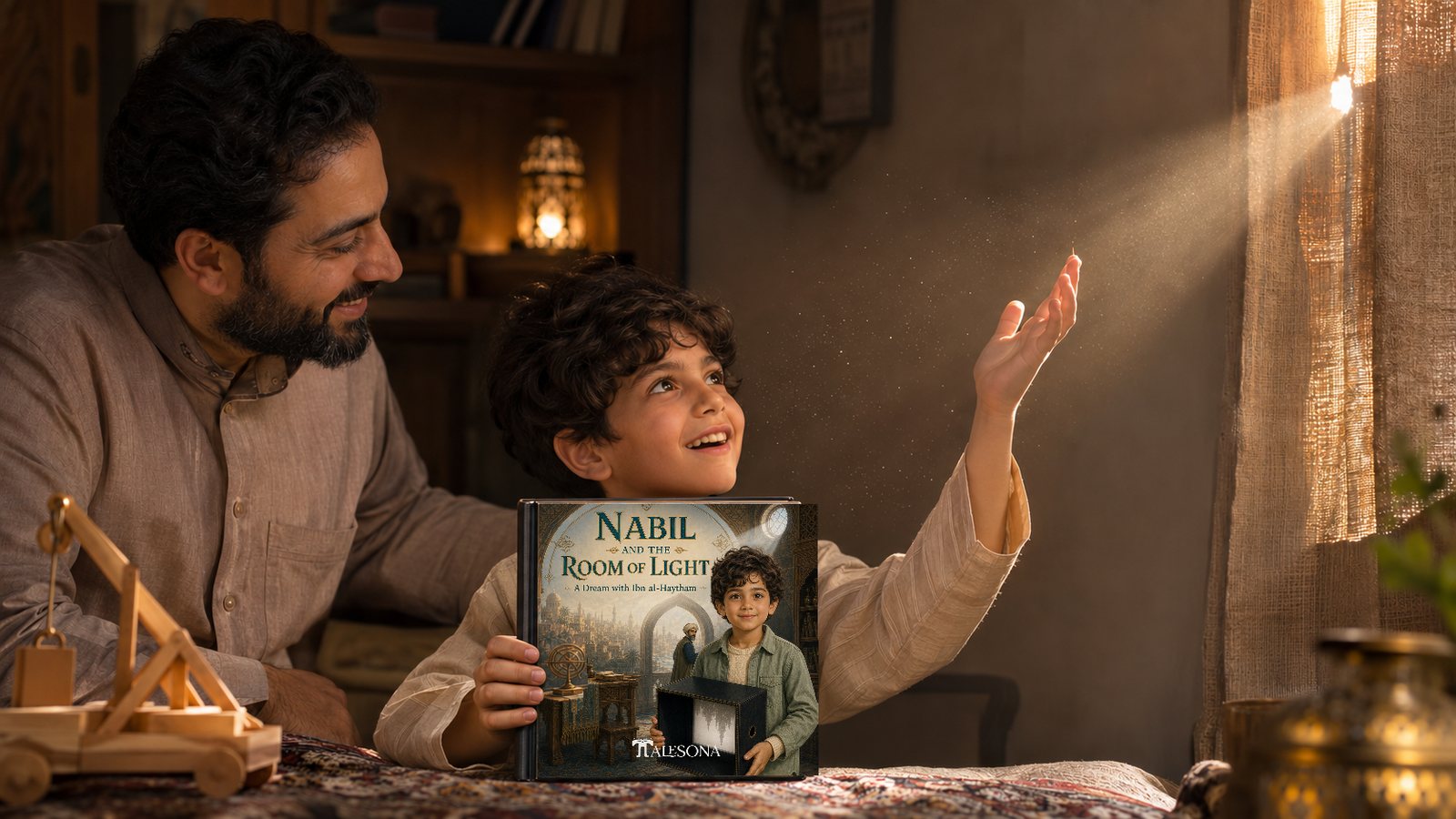
Ibn al-Haytham (c. 965–c. 1040) was a scientist from Basra who spent much of his life in Cairo and studied light and vision. His Book of Optics argued, using experiments, that we see because light enters our eyes. Al-Jazari (1136–1206) was an engineer who served the Artuqid rulers; in 1206 he completed the Book of Knowledge of Ingenious Mechanical Devices, describing clever machines including his famous elephant clock.
Both are wonderful heroes for children: one teaches us to test our ideas, the other to build them.
Who was Ibn al-Haytham?
The short version for kids
More than a thousand years ago, a man from the city of Basra wanted to know how we see. Many people then believed our eyes sent out invisible rays, like torches. Ibn al-Haytham asked: Is that really true? How can we check? He did experiments with light, mirrors and dark rooms, and showed that light travels from things into our eyes. That's how we see!
The facts for parents
- Dates and places. Encyclopaedia Britannica gives his life as c. 965 in Basra (in today's Iraq) to c. 1040 in Cairo, Egypt. He spent much of his working life in Cairo, where he wrote and taught.
- His great work. His Book of Optics (Kitab al-Manazir) ran to seven books. The first three, on direct vision, were translated into English by the historian of science A. I. Sabra.
- His big idea. Earlier thinkers such as Euclid and Ptolemy had taught that vision worked by rays coming out of the eye. Ibn al-Haytham argued from experiment for the opposite: that light comes from objects into the eye.
- The dark room. He studied how light passing through a tiny hole into a dark room projects an upside-down image on the opposite wall, the principle behind the camera obscura and, much later, the camera.
- Testing, not just guessing. He is widely credited with making careful experiment the way to prove ideas in optics, and some call him a pioneer of the scientific method.
- His reach. His Optics was translated into Latin around the turn of the 13th century, and a printed edition appeared in Basel in 1572. In Europe he was known as Alhazen.
- Still celebrated. UNESCO marked his achievements at the launch of the International Year of Light in Paris in January 2015.
Try it at home: a pinhole viewer
With an adult's help, make a tiny hole in one end of a shoebox and tape baking paper over a window cut in the other end. Point the hole at a bright window (never at the sun) and look at the paper. You'll see a small upside-down picture of the scene, just as Ibn al-Haytham described. Ask your child: Why do you think it's upside down?
Who was al-Jazari?
The short version for kids
Around 800 years ago, an engineer named al-Jazari worked for kings in the lands that are now south-eastern Turkey. He loved to invent: water machines, fountains, and clocks with moving figures. His most famous invention was a giant clock shaped like an elephant. Every half hour a bird whistled, a little man dropped a ball into a dragon's mouth, and the elephant's driver tapped the elephant. Then he wrote a book so other people could build his machines too!
The facts for parents
- His name. His full name is usually given as Badi' al-Zaman Abu al-'Izz Isma'il ibn al-Razzaz al-Jazari.
- Dates and work. He lived 1136–1206 and served as an engineer for the Artuqid rulers in Upper Mesopotamia. Little is known about his personal life, but the Science Museum Group notes he is thought to have been chief engineer at the Artuqid palace in Mardin.
- His book. In 1206 he presented his Book of Knowledge of Ingenious Mechanical Devices (Kitab fi ma'rifat al-hiyal al-handasiyya), with instructions and drawings for machines including water-raising devices, fountains and clocks.
- The elephant clock. The Metropolitan Museum of Art describes it: every half hour, a bird on the dome whistles, a man drops a ball into a dragon's mouth, and the driver strikes the elephant with his goad.
- A clock of many cultures. According to al-Jazari's own description (as summarised by Oxford's Museum of the History of Science), the elephant represents Indian and African cultures, the dragons Chinese culture, the phoenix Persian culture, the water mechanism Greek culture, and the turban Islamic culture.
- More inventions. His book also describes a hand-washing device with figures offering soap and a towel, and a boat of musical automata.
Try it at home: a simple water timer
Poke a small hole in the bottom of a paper cup, hold it over a glass and fill it with water. How long does it take to empty? Mark the glass every minute. You've just made a very simple water clock. Then ask your child to draw their own "ingenious machine", the more animals and moving parts the better.
Why these heroes matter for children
- Curiosity is a virtue. Both men looked at ordinary things (light, water, time) and asked "how?"
- Testing beats guessing. Ibn al-Haytham's careful experiments show children that it's good to check an idea, even a famous one.
- Making is sharing. Al-Jazari wrote down his methods so others could learn. Knowledge grows when it's shared.
- Identity. For Muslim children especially, these figures show that people from their own heritage helped shape science and engineering, and that faith and curiosity can sit side by side.
In The Room of Light, children meet Ibn al-Haytham; in The Elephant Clock, they step into the world of al-Jazari. When the young hero in those pages has your child's face, the message is personal: you can be curious and clever too. For children who look further up, The Little Astronaut continues the same spirit of discovery.
Talking about them by age
- Ages 3–5: Focus on wonder. "Light comes into your eyes!" "An elephant clock!" Do the activities together.
- Ages 6–8: Introduce the idea of an experiment: guess, test, see what happens.
- Ages 9–10: Talk about how ideas travel, from Arabic manuscripts to Latin translations to modern science.
Key takeaways
- Ibn al-Haytham (c. 965–c. 1040) argued from experiment that we see because light enters the eye.
- He studied the "dark room" effect behind the camera obscura and was known in Europe as Alhazen.
- Al-Jazari (1136–1206) completed his Book of Knowledge of Ingenious Mechanical Devices in 1206.
- His elephant clock marked each half hour with moving figures and celebrated many cultures.
- Simple home activities (a pinhole viewer, a water timer) bring their ideas to life.
Sources
- Encyclopaedia Britannica. Ibn al-Haytham. https://www.britannica.com/biography/Ibn-al-Haytham
- Ibn al-Haytham, The Optics of Ibn al-Haytham, Books I–III: On Direct Vision, trans. A. I. Sabra (Warburg Institute, 1989). Catalogue description: https://monoskop.org/log/?p=11994
- Bibliotheca Alexandrina, SCIplanet. The Arabs and the enlightenment of optics. https://www.bibalex.org/SCIplanet/en/Article/Details.aspx?id=5200
- HistoryofInformation.com. Ibn al-Haytham founds experimental physics, optics, and the science of vision. https://www.historyofinformation.com/detail.php?id=2047
- High Altitude Observatory (NCAR/UCAR). Ibn al-Haytham (Alhazen). https://www2.hao.ucar.edu/Education/FamousSolarPhysicists/ibn-al-haytham-alhazen
- UNESCO launch: "1001 Inventions and the World of Ibn Al-Haytham" (2015). https://www.ibnalhaytham.com/?p=932
- The Metropolitan Museum of Art. "The Elephant Clock", folio from a Book of the Knowledge of Ingenious Mechanical Devices by al-Jazari. https://www.metmuseum.org/toah/works-of-art/57.51.23
- Science Museum Group Collection. Ismail ibn al-Razzaz al-Jazari. https://collection.sciencemuseumgroup.org.uk/people/cp52302
- History of Science Museum, University of Oxford. Ismail al-Jazari's elephant clock, c. 1200. https://www.cabinet.ox.ac.uk/node/9789
- National Geographic. Medieval robots? They were just one of this Muslim inventor's creations. https://www.nationalgeographic.com/history/world-history-magazine/article/ismail-al-jazari-muslim-inventor-called-father-robotics
Would your child like to meet these heroes, as a hero themselves? See a free preview of The Room of Light or The Elephant Clock.
FAQ
Why is Ibn al-Haytham called the "father of optics"?
Because his *Book of Optics* used experiments to explain how light and vision work, and it influenced later scientists in Europe, where he was known as Alhazen. The title is a popular label rather than an official one.
Did al-Jazari invent the robot?
Not in the modern sense, but his book describes automata, moving figures powered by water and mechanisms, which is why some writers connect him with the early history of robotics.
What age are these stories suitable for?
The facts can be shared at any age with simple words. Talesona stories are written for roughly ages 2 to 10.
Where can I see al-Jazari's elephant clock?
Illustrated pages from copies of his book are held in museum collections, including the Metropolitan Museum of Art in New York, which has a page showing the elephant clock dated 1315.
Are these figures only for Muslim children?
Not at all. They belong to the history of science every child inherits, and show how knowledge travels between cultures.