
How to Teach Wudu to Children: A Calm Practical Guide
Teach wudu to children by showing the sequence slowly, practising together and using a short checklist they can follow. Explain that wudu is a way of preparing for prayer, then focus on water reaching the right places rather than speed. A calm demonstration is easier to learn from than repeated corrections shouted across the bathroom.
Begin with meaning and a safe place to practise
Tell your child that Muslims perform wudu before prayer when it is needed. The Quran describes its main actions in Surah al-Ma'idah, verse 6. You do not need a frightening story about mistakes or a complicated discussion to begin. Let the child watch you and ask ordinary questions about what you are doing.
Check the water temperature, use a stable step if needed and keep the floor dry. Stay beside a young child. A low flow of water makes it easier to see each action without splashing everywhere. Prepare a towel and make sure the child can reach the tap without climbing or leaning dangerously over the basin.
Show the complete sequence
The following is a practical outline of a complete wudu, drawing on the description of Uthman's demonstration in Sahih al-Bukhari 159 and the explanation in Islam Question & Answer, question 11497. Sunni scholars differ about some details and which actions are obligatory. Teach consistently with a trusted teacher rather than telling a child that every small variation is wrong.
- Make the intention in the heart, without saying it aloud, then say “Bismillah.”
- Wash both hands three times.
- Rinse the mouth and draw water gently into the nose three times, blowing it out with the left hand.
- Wash the face three times, from the hairline to the chin and from ear to ear.
- Wash the right arm from the fingertips up to and including the elbow three times, then the left arm the same way.
- With freshly wet hands, wipe the head once: start at the front, pass the hands back to the nape, then bring them back to the front. Then wipe the ears once, with the index fingers inside the ears and the thumbs over the back of the ears.
- Wash the right foot up to and including the ankle three times, then the left foot the same way. Pay attention to the heels and between the toes.
- Afterwards, say: “Ashhadu an la ilaha illallahu wahdahu la sharika lah, wa ashhadu anna Muhammadan ‘abduhu wa rasuluh” (I bear witness that there is no god but Allah alone, with no partner, and I bear witness that Muhammad is His slave and Messenger), as reported in Sahih Muslim 234.
The way of wiping the head, from front to back and back again, is described in the hadith of ‘Abdullah ibn Zayd in Sahih al-Bukhari 185. Islam Question & Answer 11497 lists the obligatory parts of wudu as washing the face (including rinsing the mouth and nose), washing the arms up to the elbows, wiping the whole head (including the ears), washing the feet up to the ankles, keeping this order, and doing it without a long break between parts. Your child does not need to memorise this list, but it helps you know what to check when correcting.
Demonstrate the movements close enough for your child to see. Explain unfamiliar words such as elbow and ankle by pointing to them. For the nose, model a gentle action rather than asking a beginner to draw water forcefully. Do not turn the sequence into a race.
Separate learning cues from religious requirements
A coloured card, a counting finger or a phrase you use to remember the next action is a teaching aid. It is not an additional part of worship. Explain this clearly if you make a home checklist, especially if your child later sees another family using a different reminder. Avoid the special du'as for each body part that circulate on some cards: none is authentically reported from the Prophet (peace be upon him). Bismillah at the start and the testimony afterwards are enough.
It also helps to explain that three washes are the most complete way, but not the only valid number for the parts that are washed. The Prophet (peace be upon him) also performed wudu washing each part once, and twice; see Sahih al-Bukhari 157 and 158. Washing more than three times is not taught. One complete wash differs from a splash that leaves part of the required area dry. The head is wiped, so do not simply tell the child to wash everything three times.
Practise with one clear focus
Choose a time when you are not rushing out of the house. First let the child watch a whole demonstration. Next, perform wudu alongside them and give brief prompts. On another occasion, invite them to tell you the next step. This gives you a way to see what they remember without turning the session into a public test.
- When the order is difficult: use a simple sequence card and point to the next action.
- When water misses an area: demonstrate how your hand helps water reach it.
- When counting takes over: bring attention back to a complete, careful wash.
- When the child is tired: leave extra explanation for a calmer practice time.
Give specific feedback such as “You remembered your elbow,” rather than making a sweeping promise about the reward for a particular performance. Encourage care while remembering that a child is learning a physical sequence as well as new vocabulary.
Handle mistakes without creating a cycle of doubt
Stay close enough to notice what actually happened. If the child has missed an area, explain the concrete issue and help them correct it. If a question about validity or sequence goes beyond what you know, ask a knowledgeable teacher. Do not invent a ruling simply to finish the conversation.
A repeated “What if?” needs a calm response. Avoid asking a child to restart again and again because neither of you feels perfectly certain. Demonstrate the action clearly and distinguish a visible omission from a passing worry. If worry repeatedly makes the routine distressing, seek appropriate support rather than increasing the number of checks.
Use water carefully
Let your child experiment with the tap before practising: what flow allows them to wash comfortably without spraying the floor? Turn it down together and keep the explanation practical. A child can learn care for water alongside care in worship without being blamed for every drop. An adult should handle any slippery floor promptly.
Remove anything that prevents water from reaching the required skin, such as a layer of craft paint. Explain the actual problem rather than treating ordinary play as something shameful. If a skin condition, dressing or medical instruction affects washing, get suitable medical and religious guidance for that individual situation. This basic lesson does not cover every exception.
Bring the routine into family life
A child who watches family members prepare calmly has a useful model. Give them room at the basin and avoid comparing their speed with a sibling. Older children may prefer a private reminder; younger children may enjoy telling you which action comes next. Adapt the help as they become more independent.
Keep any checklist simple enough to glance at. You might write action names in English and add Arabic terms the child already hears at home. There is no need to memorise several unfamiliar words before they can begin practising. Accurate action and understanding can grow together.
A story alongside the practical lesson
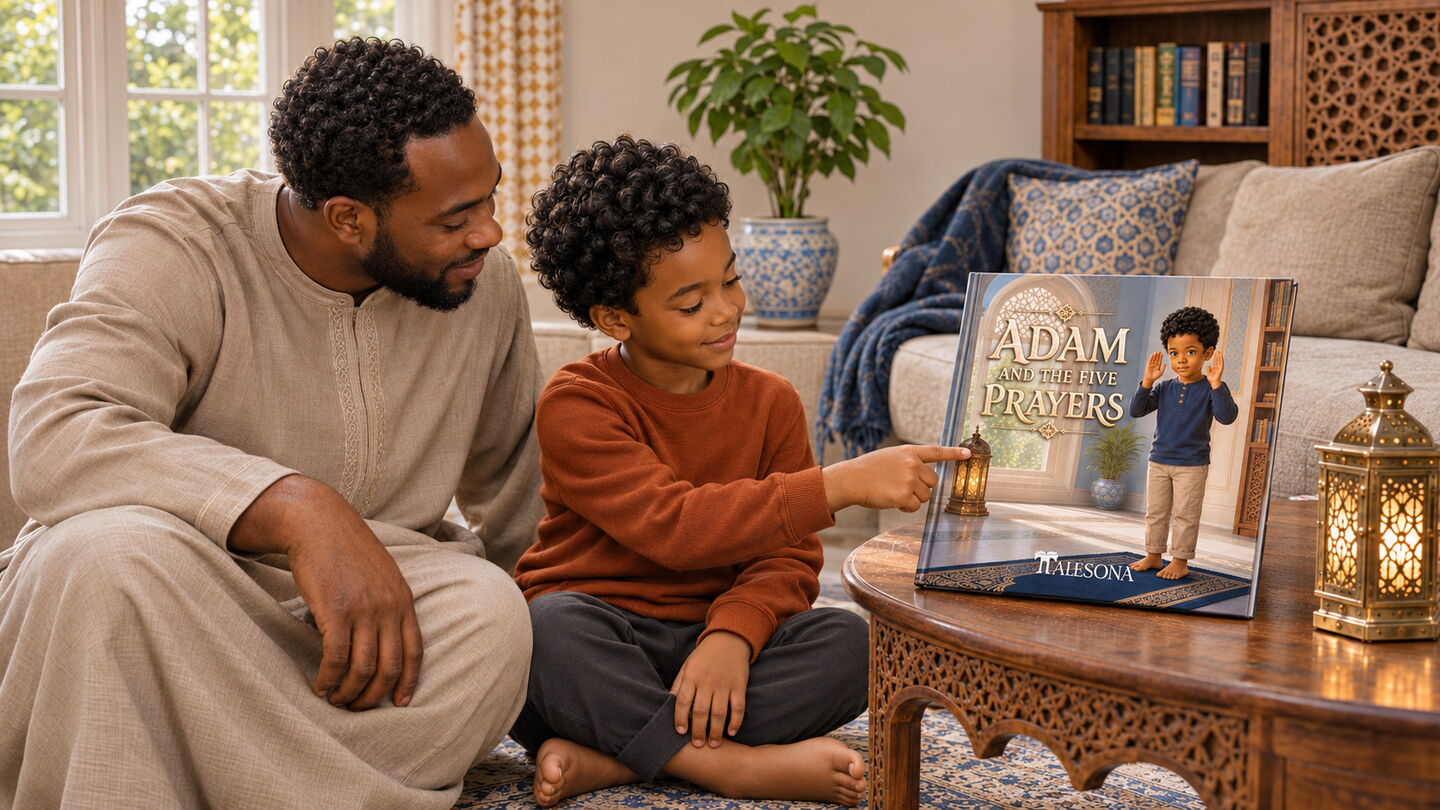
For a broader conversation about prayer, explore Talesona's The Five Prayers for boys, listed for ages seven to twelve, or Five Prayers for girls, listed for ages six to eight. These are prayer-themed choices, not a replacement for a wudu demonstration or a religious teacher. Talesona can include a child's name and picture, with printed and PDF options and a preview before printing.
Keep the next step achievable
After practice, ask what your child found easy and what they would like you to show again. Choose one useful focus for next time, such as remembering the order or reaching the ankles carefully. A steady, kind approach gives the child space to ask questions and gradually take responsibility for the routine.
FAQ
Must every part be washed three times?
No. Three is the most complete; one full wash of each part is valid, as is twice. The head and ears are wiped once.
Should my child say the intention aloud?
No. The intention is in the heart and is not spoken; the child simply says Bismillah before starting.
What if my child forgets the order?
Keeping the order is obligatory, so go back through the steps in the right order with them. A simple sequence card helps.
Is there a du'a after wudu?
Yes. The testimony “Ashhadu an la ilaha illallahu wahdahu la sharika lah, wa ashhadu anna Muhammadan ‘abduhu wa rasuluh” is reported in Sahih Muslim 234.
Is a storybook enough to teach wudu?
No. A story can open a conversation, but a child also needs an accurate practical demonstration and guidance.
What if washing is affected by a medical condition?
Seek appropriate medical and religious guidance for the individual situation rather than applying a general checklist.